
How to Search the Travis County Court Docket
Know the court level before you type a name. That one choice decides which Travis County docket system holds the case. The County Clerk Court Data page sends misdemeanor, probate, and County Courts at Law searches into Odyssey. The District Clerk case information page covers district civil and family cases from 2006. Criminal cases there date from 2008. Justice Court and city matters live in separate systems. A statewide option exists too: re:SearchTX. Its document coverage and access level differ from local portals.
Gather the right details first. A full party name, an approximate filing date, and the court type will carry you a long way. A cause number works best of all, since it narrows a court docket search to a single case. Try former spellings whenever a name may have changed. Before trusting any match, compare the court, the party role, the filing date, and the case type. Only then can you call it the right Travis County case.
- Identify whether the record belongs to a District Court, County Court at Law, Justice Court, probate court, or municipal court.
- Open that court's official portal and choose the correct location or case category.
- Search by exact cause number when available. Otherwise use a party name and date range.
- Read the event list for filings, signed orders, settings, resets, and disposition entries.
- Ask the correct clerk for a certified copy when an official document is required.
Travis County Odyssey Search Details
Smart Search in Odyssey takes a name or a cause number. The catch is routing. On the County Clerk side of the Travis County portal, the court location checkbox has to include County Clerk, or even a correct cause number may return nothing useful. Results cap at 200. Only six columns display. Tight filters beat a broad surname search every time.
The official Travis County Odyssey user guide walks through the result filters and the Hearings tab. It also shows how case events appear. An event list shows the first 50 entries, with controls to load more. Your browser's find tool can speed up a long docket history, though the safest habit is to scan past the first entry that answers your question. A later order or reset can change what that earlier event meant.
| Search field | Best use | Local caution |
|---|---|---|
| Smart Search | Party name or cause number | Select the right court location |
| Advanced filters | Date and case category | Broad searches may hit the 200-result cap |
| Hearings | Future and recent settings | Confirm later resets with the court |
| Case Events | Chronological docket history | Use Show More or Show All for long files |
What a Court Docket Shows
Think of a Travis County docket as an event index. It is not the full case file. Most entries name the court and the cause number. The parties and the case category follow. Filing dates, scheduled hearings, orders, and the latest status round out the record. Some dockets link straight to document images. Others demand an account, a payment, or a higher access role. And a printed screen is never a certified record; only a clerk issues one of those.
| Case number | Local cause numbers such as D-1-DC-24-000001 help identify the court and case. |
|---|---|
| Parties | Names and roles such as plaintiff, defendant, applicant, or respondent. |
| Entries | Filed pleadings, notices, orders, service returns, and other events by date. |
| Settings | Hearing date, time, docket type, court, room, and later reset information. |
| Disposition | The recorded outcome, such as judgment, dismissal, conviction, or transfer. |
A filing entry proves only one thing. The document entered the record. Nothing more. It cannot tell you the judge granted the request, so look for a signed order or final judgment. A setting entry works the same way, since a hearing date on the docket is not proof the hearing happened. Continuance, reset, and cancellation entries that come later control the answer.
Two Travis County Docket Keepers
Two elected offices split the docket-keeping in Travis County. The District Clerk holds District Court criminal, civil, and family records. The County Clerk keeps misdemeanor, probate, and County Courts at Law material. Justice Courts and the city's municipal courts retain their own files. This division explains many dead-end searches. The same Odyssey technology sits behind different entry points. It never merges into one combined file room.
The county's court system overview lays out the full range of local courts and programs. Its court categories point you toward the right office before any name search begins. That same overview shows why a Travis County court docket can never shrink into one simple database.
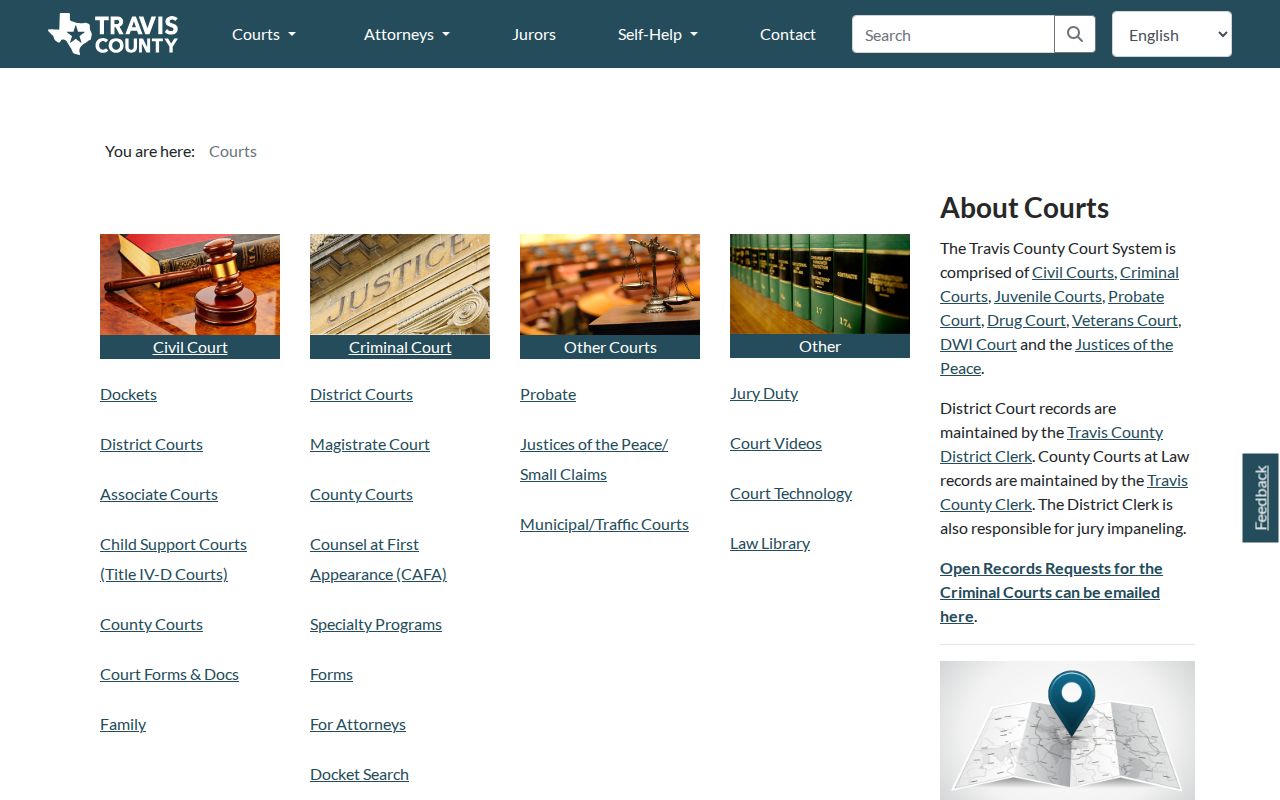
The county court landing page breaks out criminal, civil, probate, justice, juvenile, and specialty routes. Each route can hold different docket information.
Which Courts Keep Dockets
Texas trial jurisdiction overlaps by case type, claim size, offense level, and location. District Courts handle felony prosecutions. They also carry broad civil and family jurisdiction. County Courts at Law take misdemeanors and assigned civil matters. Justice Courts hear small claims, eviction, debt, and many traffic cases, while municipal courts cover city ordinance and fine-only Class C offenses. Probate Courts maintain estate, guardianship, and related dockets.
| Court | Docket covers | Custodian or search |
|---|---|---|
| District Courts | Felony, civil, family, juvenile | District Clerk portal and records desk |
| County Courts at Law | Misdemeanor and assigned civil cases | County Clerk Odyssey |
| Justice Courts | Small claims, eviction, debt, precinct traffic | JP Public Access and precinct clerk |
| Probate Courts | Estate, guardianship, mental health | County Clerk probate and court schedules |
| Municipal Courts | City ordinance and fine-only cases | Each city's court or portal |
Federal cases stand apart. Travis County sits in the Austin Division of the U.S. District Court for the Western District of Texas. Those dockets run through PACER and federal CM/ECF, not the county systems.
Travis County Courthouse Docket Routes
Walking in takes planning too. Civil and family District Clerk service sits at the Civil and Family Court Facility. The address is 1700 Guadalupe Street, Austin. Criminal court records route through the Blackwell-Thurman Criminal Justice Center area. That address is 509 West 11th Street. The historic courthouse and Justice Court functions add one more downtown stop. Call ahead. The right counter depends on the case type and the office that holds the record.
The District Clerk contact page lists the civil and criminal divisions, current hours, phone lines, and email channels. Its separate service blocks show how split the county's physical routing really is.
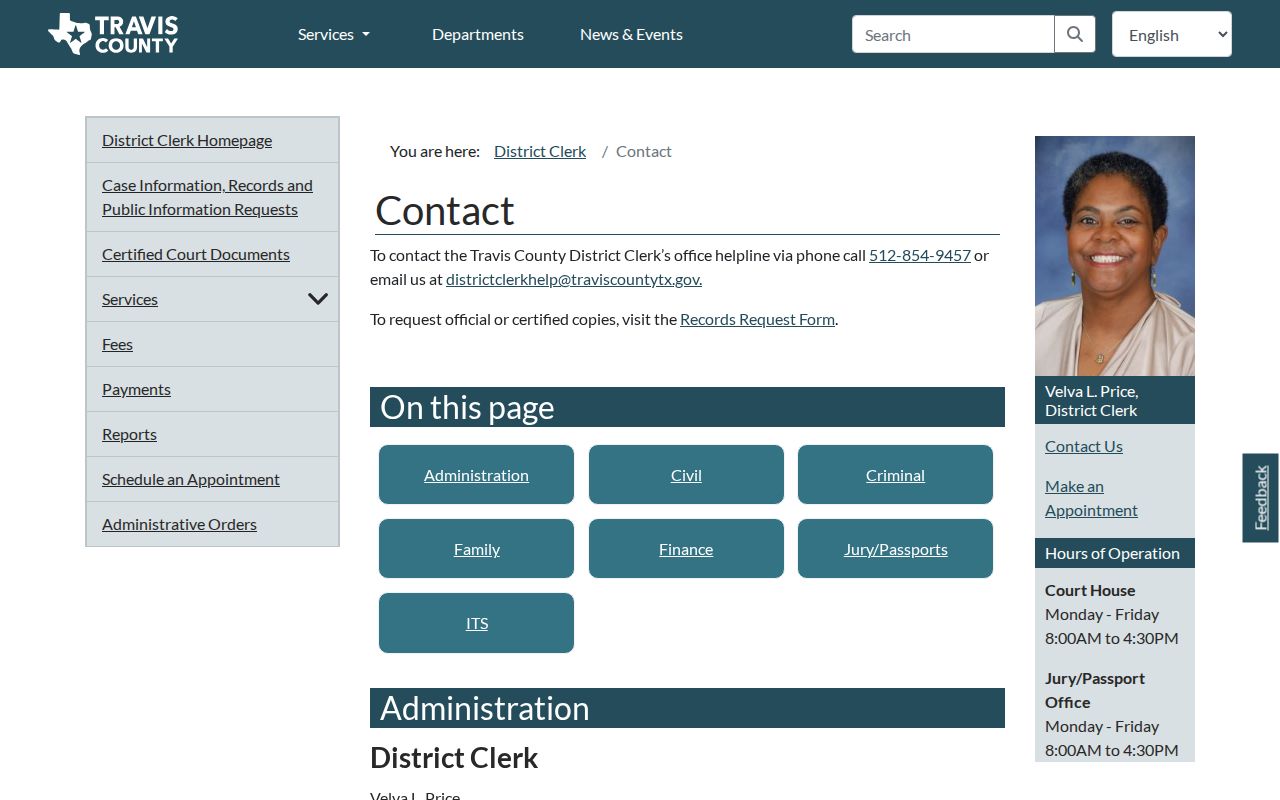
Confirm the division before mailing a request or arriving at a counter.
Finding Court Dates and Settings
A court setting can surface in several places. Odyssey's Hearings section is one source. So are a live criminal docket application, a PDF docket report, and the Civil and Family Court Facility web docket. Results often list the setting date, time, room, floor, docket type, and assigned court. A notice in the case file may add details the calendar view leaves out.
Always hunt for later reset or continuance entries. Most civil District Court settings run through central Court Administration. One exception: the 250th District Court stopped using centralized docketing on September 1, 2025. Its coordinator is the better confirmation route for affected settings. The full Travis County court calendar walkthrough explains these local paths. It also covers missed-setting checks.
Confirm the setting: A portal date can move. Contact the assigned court or coordinator before relying on a hearing time.
Travis County Probate Court Dockets
Probate Courts in Travis County run two calendars. One is a regular calendar, and one covers uncontested matters. Heirship and guardianship cases follow their own forms and coordinator instructions. Some filings switch tracks. A matter involving common-law marriage, disputed adoption, DNA evidence, declaratory relief, or expert testimony can move to the regular probate docket. That can happen even when no party has filed a contest. The Travis County probate hearing schedule gathers the calendars, forms, and coordinator guidance in one place. Remote access is not a general promise. Probate Court 2 permits remote settings only for specified uncontested matters and certain out-of-state witnesses. The assigned court's instructions control. One caution: a calendar label reflects procedure. It does not say whether every document in the underlying file is open for remote viewing.
Travis County Public Docket Access
Texas does not treat court-case records like ordinary agency records. The Texas Public Information Act covers many administrative files. Judiciary case files work differently. They run through court rules, clerk procedures, and common-law rights. Requesting an existing clerk document is one thing. Asking an office to create a report or perform legal research is another.
Key access authorities:
Texas Government Code Chapter 552 governs public access to many government records, subject to its judiciary limits.
Texas Rule of Judicial Administration 12 sets a process for judicial administrative records, not ordinary filed case records.
Texas court access and redaction rules control sensitive data, remote electronic access, and sealing procedures.
Not every Travis County docket entry is open. Juvenile, adoption, mental-health, sealed, and some family records may be hidden or limited, and redacted public views can omit protected identifiers. A blank result proves little. It can mean the wrong venue, older coverage, a new filing delay, or restricted access rather than no case at all.
Travis County Docket Sheets and Files
Think of the docket sheet as the timeline. The case file holds the pleadings, orders, returns, exhibits, and judgments behind each entry. Certification adds the clerk's authentication. Pick the least costly version that meets the need. A current setting may only require the event screen. A formal filing with another office may require a certified copy.
Fees differ by clerk. Current District Clerk fees list paper copies at $1 per page. Electronic copies run $1 for the first ten pages and ten cents for each added page, plus $5 per certified document. The County Clerk publishes separate civil, misdemeanor, and probate schedules. Match the request to the right office. An older District Clerk request PDF displays different email and certification amounts, so confirm costs on the live District Clerk fee page before payment.
Travis County Clerk Docket Records
District Court documents travel several routes. Search online, request by mail, use the records form, or visit the right counter. The form lets a requester name exactly what is needed, whether a docket sheet, final judgment, petition, answer, order, jury verdict, full file, or another specific document. It also asks about certification and delivery. County Court at Law, misdemeanor, and probate requests go to the County Clerk instead.
Start with the Travis County District Clerk service page. It is the official entry point for district records. Its links separate case information, copy requests, fees, and division contacts. Each division lists its own contacts.
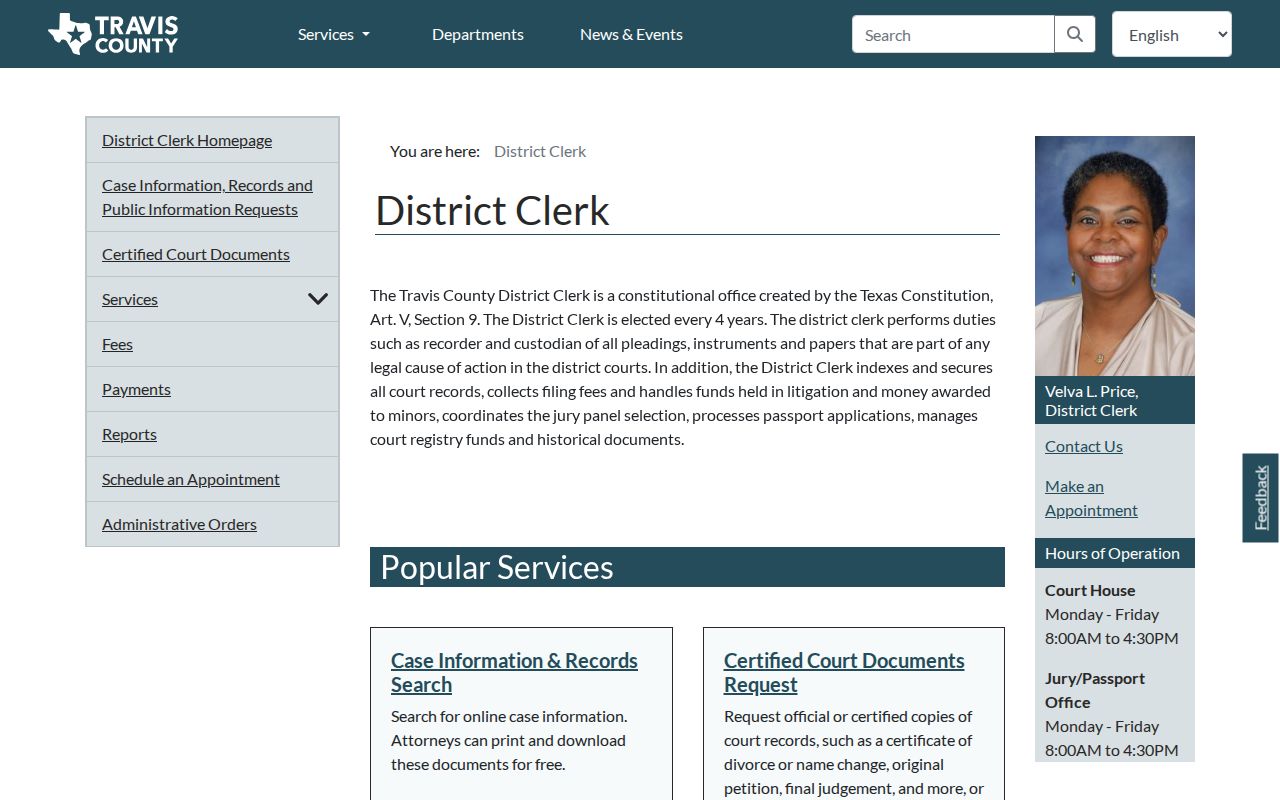
The District Clerk keeps the records for the District Courts. For the county's other local trial courts, the County Clerk holds the docket files.
Travis County Docket Technology
Travis County records span several generations of systems. Not everything is online. County Clerk indexes start at different dates by case type: civil data from June 1986, misdemeanor data from January 1981, and probate data from July 1992. Image coverage begins later still. The District Clerk's public online coverage starts in 2006 for civil and family cases. Criminal cases begin there in 2008. Older records may require microfilm, paper, or a staff-assisted search.
Texas added a statewide layer in late 2018 with role-based re:SearchTX access. A 2024 Texas Judicial Council report described a Supreme Court integration deadline. It applies to district and county clerks. The deadline is November 1, 2025. Statewide deadlines do not erase local custody rules. The cited re:SearchTX inventory also excluded criminal case records from its scope. Keep the tools straight. eFileTexas is the filing system for parties and lawyers. By contrast, re:SearchTX is the related search and access layer.
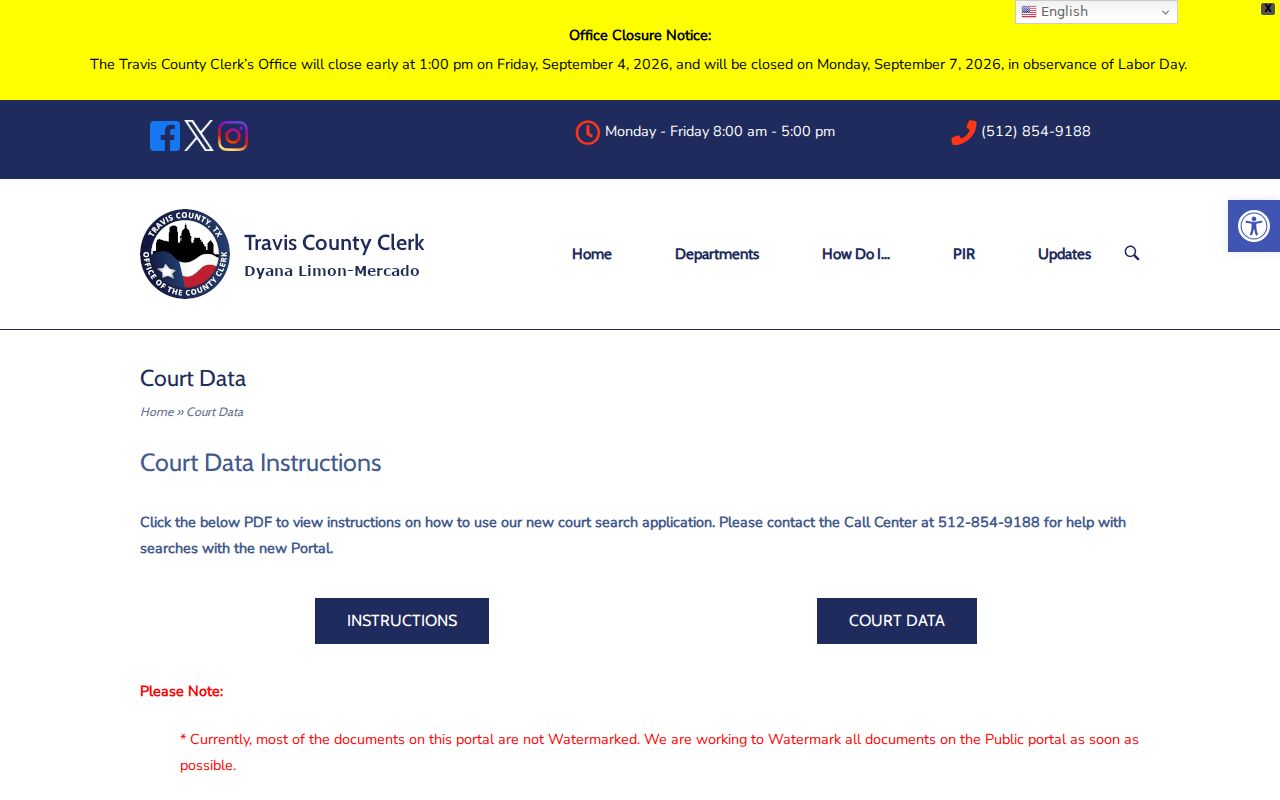
Technology also changes what a result means. The County Clerk describes its current Odyssey application as a new court search, and notes that most displayed documents are not watermarked while work continues. No watermark means no certification. District Clerk pages draw a clear line between free public viewing and paid official copies. If a portal shows only metadata, skip the full-file order. Use the event date and document title to make a precise clerk request instead.
- Register of Actions
- The dated event list within an Odyssey case view.
- eFileTexas
- The electronic filing route, not a guarantee of public document access.
- re:SearchTX
- A statewide search and document-access layer with role-based limits.
- Redacted image
- A public copy with protected details removed.
Travis Dockets by the Numbers
Caseload quotes need the right court level. Official fiscal year 2024 reports make that plain. Travis County District Courts reported 34,121 cases added and 32,214 disposed. That total spans civil, family, criminal, and juvenile categories. Justice Courts reported 78,668 added and 64,075 disposed. Adding the groups together would misstate the docket. Each covers a different jurisdiction and reporting population.
The Travis Criminal Data Dashboard supplies newer monthly context for the Travis County criminal docket. It defines clearance rate as disposed cases divided by added cases. It also explains which clerk reports each category. Its measures stay separate. Pending, added, reactivated, inactive, and disposed count different things. So "added" is not every matter handled during the year.
"Disposed" does not mean every file went online either. For the District Court total, 50,940 cases remained actively pending at year end. Justice Courts reported 77,734 pending. Those counts explain portal delays and crowded calendars. They do not predict the timing of any one Travis County case.
Court Dockets by City in Travis County
City cases never land in a County Clerk docket. Austin, Pflugerville, Lakeway, Manor, and Lago Vista each run their own court. These municipal courts handle citations and ordinance matters. A traffic ticket written inside city limits lives with that city. It does not live with Travis County. The cards below follow the county-only 2017 population ranking. Pflugerville is the one to watch, since its boundaries spill into Williamson County too. Before you try a Travis County Justice Court, search the court named on the citation itself. The County Clerk Court Data page shows the county portal route for County Clerk cases. Its Odyssey instructions will not substitute for a city's own municipal docket search.
Use the city cards to move from county routing to the municipal court that actually holds the citation record.
Austin Court Docket
Municipal traffic, ordinance, parking, juvenile, and fine-only cases.
Pflugerville Court Docket
City traffic, ordinance, and Class C misdemeanor matters.
Lakeway Court Docket
Municipal cases, court-of-record procedures, and Teen Court.
Manor Court Docket
City misdemeanor records and clerk-based request routes.
Lago Vista Court Docket
In-person dockets and Court of Record No. 1 matters.
Map and Directions to the Travis County Civil and Family Court Facility
District civil, family, and the two civil County Courts at Law are heard at the Civil and Family Court Facility (CFCF), 1700 Guadalupe Street in downtown Austin, where the District Clerk's civil/family records counter sits on the third floor, Room 3.200. Felony criminal cases are heard separately at the Blackwell-Thurman Criminal Justice Center's Gault Annex, 501 West 11th Street, where the District Clerk's Criminal Division keeps its counter on the second floor, Room 2.300. A Travis County District Court case can therefore sit in either downtown building depending on whether it is civil/family or felony criminal.
District Clerk Civil and Family
1700 Guadalupe Street, Room 3.200
Austin, TX 78701
512-854-9457
Monday through Friday, 8:00 a.m. to 4:30 p.m.
District Clerk Criminal Division
501 West 11th Street, Room 2.300
Austin, TX 78701
512-854-9420, option 3
Monday through Friday, 8:00 a.m. to 4:30 p.m.
The county's criminal courthouse requires security screening, and confiscated items are not returned, so leave prohibited items in the car; metered street parking around that building accepts coins and cards, and Capital Metro service is linked from the criminal court contact page. The downtown civil/family facility is likewise a secured building with its own prohibited-item list. Both buildings offer disability access and interpreter arrangements on request, but call the relevant office ahead of a visit to confirm current screening and accommodation details.