
How to Search Criminal Dockets
For upcoming settings, go straight to the official Travis County Criminal Docket Search. It looks up felony and misdemeanor court dates by arrested person's name, attorney name or State Bar number, judge or court number, or case number. Broad name search getting noisy? Use its future-setting PDF reports, which sort by attorney or arrested person, plus separate district and county calendars.
Case history lives elsewhere. The District Clerk's public Odyssey route handles felonies, while the County Clerk Court Data route covers the County Courts at Law. A statewide re:SearchTX query can add context, though it never proves every Travis County criminal case is included. Municipal and JP Class C cases sit outside both felony and misdemeanor paths.
- Identify whether the matter is a felony, Class A or B misdemeanor, or Class C case.
- Search by exact cause number when available, including its prefix and year.
- Try a name, attorney, judge, or court number if the cause number is unknown.
- Compare the setting date, court, charge, and current case status.
- Ask the proper clerk for a certified copy when an official record is needed.
The official criminal docket page shows the distinct search and calendar routes.
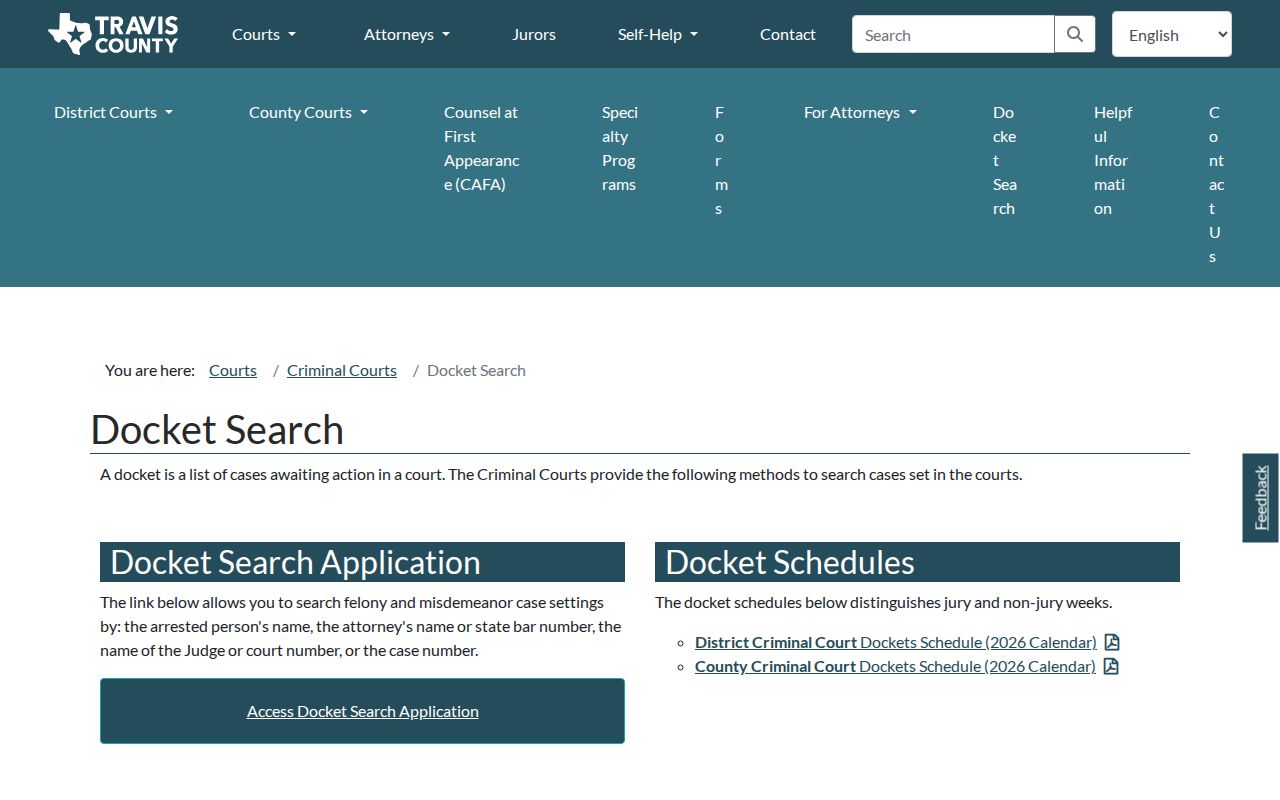
Keep two tools straight. A setting report answers when; the full Register of Actions answers what happened.
Travis Criminal Clerks Compared
A Travis County criminal docket search often fails. The cause is usually simple: the searcher called the wrong clerk. The District Clerk Criminal Division holds adult felony files. It also keeps felony search warrants, felony nondisclosures, and every expunction. County Courts at Law misdemeanor files stay with the County Clerk. Five Justice of the Peace clerks keep county Class C cases. Each city keeps its own municipal docket.
| Case level | Court | Custodian |
|---|---|---|
| Felony | Criminal District Court | District Clerk |
| Class A or B misdemeanor | County Courts at Law 3-9 | County Clerk |
| County Class C | Justice of the Peace | Precinct clerk |
| City Class C or ordinance | Municipal court | Issuing city |
The County Clerk search skips ordinary municipal and JP records. The one exception is a Class C matter appealed into a County Court at Law. So read the citation or charging paper before assuming the District Clerk can find it.
What a Criminal Docket Shows
Every Travis County criminal docket opens with the basics. You get cause number, court, judge, filing date, case type, status, and case style. The party area names the state, the defendant, and any attorney where public. Charges appear in their own block. The block often lists the offense, statute, degree or class, offense date, charging instrument, and public bond data. From there, the register runs in date order. It moves through filings, hearings, pleas, orders, trial events, sentencing, and appeal activity. Read it top to bottom and the story builds itself.
| Cause number | The unique case key. D-1-DC is a Travis felony prefix. |
|---|---|
| Charge | The filed allegation and classification, not proof of guilt. |
| Setting | Date, time, type, room, court, assignment, and reset marker. |
| Events | Indictment, plea, motion, order, trial, sentence, bond, and appeal entries. |
| Disposition | Conviction, dismissal, acquittal, deferred adjudication, or another result. |
| Documents | Filed item, date, party, and public, redacted, or restricted status. |
Odyssey lists Hearings and Events newest first. The first case view shows only some entries, with controls to expand the rest. Dates deserve close reading, since a recent reset can control even while an older setting still sits lower in the register.
Travis Felony Cause Numbers
Cause-number prefixes help route a criminal docket quickly. The District Attorney tags D-1-DC as a felony pattern, and the District Clerk lists D-1-EX among criminal-related matters. A leading C leans misdemeanor. Treat these as clues, not a complete codebook.
- Indictment
- A grand jury's formal felony charging instrument.
- Arraignment
- A proceeding where the charge and plea or rights process are addressed.
- Continuance or reset
- A move from one scheduled date to another, not a final result.
- Disposition
- An outcome such as conviction, dismissal, acquittal, or deferred adjudication.
- Bond forfeiture
- An event alleging that a bond obligation was not honored.
County Clerk, JP, and municipal formats are not published in full. Copy the exact number shown rather than forcing it into the felony pattern.
Stages on a Criminal Docket
Most Travis County criminal cases follow a familiar arc: complaint or indictment, arraignment, pretrial work, plea or trial, disposition, then sentencing. One caution about motion entries. They record requests made to the judge, nothing more. So a motion on the docket is not a ruling. A plea entry and a final signed judgment are separate events too. The judgment is the one that counts.
Docket flow: Filing › Arraignment › Pretrial › Plea or Trial › Disposition › Sentencing
Separate scheduling words from outcome words. CONT, RESET, and PASS only move dates. CONV, DISM, DEFERRED, and ACQUIT speak to disposition, yet the visible label still bows to the signed order. When legal effect matters, get the judgment itself.
Nine Travis Felony Courts
Nine criminal District Courts serve Travis County: the 147th, 167th, 299th, 331st, 390th, 403rd, 427th, 450th, and 460th, plus a Magistrate Court. For assignments and individual court contacts, the official criminal District Court roster lists them.
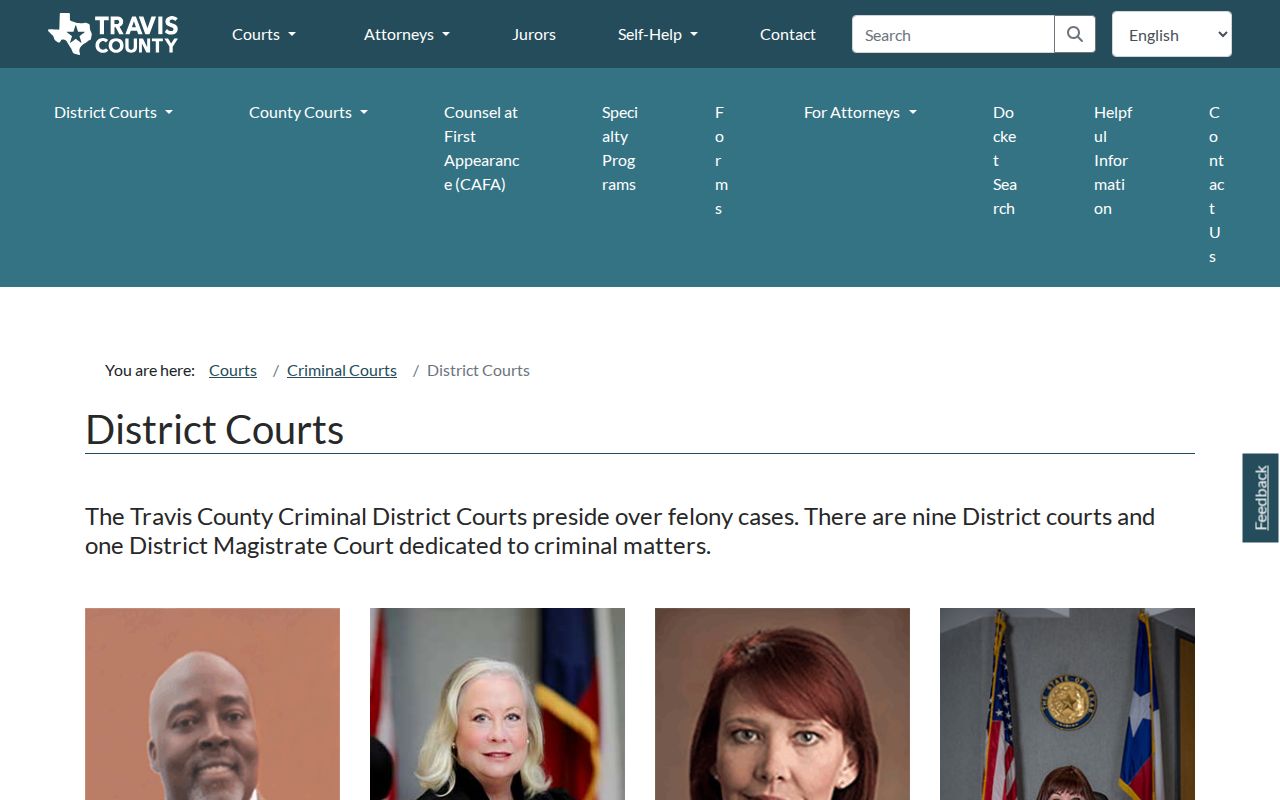
That roster earns its keep when a court date must be confirmed with the assigned coordinator rather than a general clerk line. The criminal courts landing page also helps, keeping case-date searches apart from court and records links.
The split mirrors how Travis County works. A calendar tool finds the setting, while a clerk-held file supplies pleadings and official copies.
Which Court Holds Criminal Dockets
Felony dockets belong to District Court. Class A and B misdemeanors go to Criminal County Courts at Law 3 through 9. County Court 4 serves as the Family Violence Court. County Class C matters land in one of five JP courts. A city Class C or ordinance case stays with the issuing city. For access details at the Blackwell-Thurman Criminal Justice Center, the criminal court contact page explains the options.
Need felony records in person? The District Clerk Criminal Division sits at 501 West 11th Street, Room 2.300, Austin. Hours run Monday through Friday, 8 a.m. to 4:30 p.m.
When a Charge Differs
A charge is only an allegation, never a conviction. Begin with the charge block, then follow the later pleas, orders, disposition entries, and the signed judgment. A dismissal can stay visible as a public outcome. Deferred adjudication carries court-ordered terms and is neither an acquittal nor a conviction.
Read the last controlling event. A filed motion is not a granted motion, and a reset is not a dismissal. Confirm the result in the signed order or judgment.
Want a wider view of filing activity? The Travis criminal activity dashboard filters District Clerk felony and County Clerk misdemeanor matters.
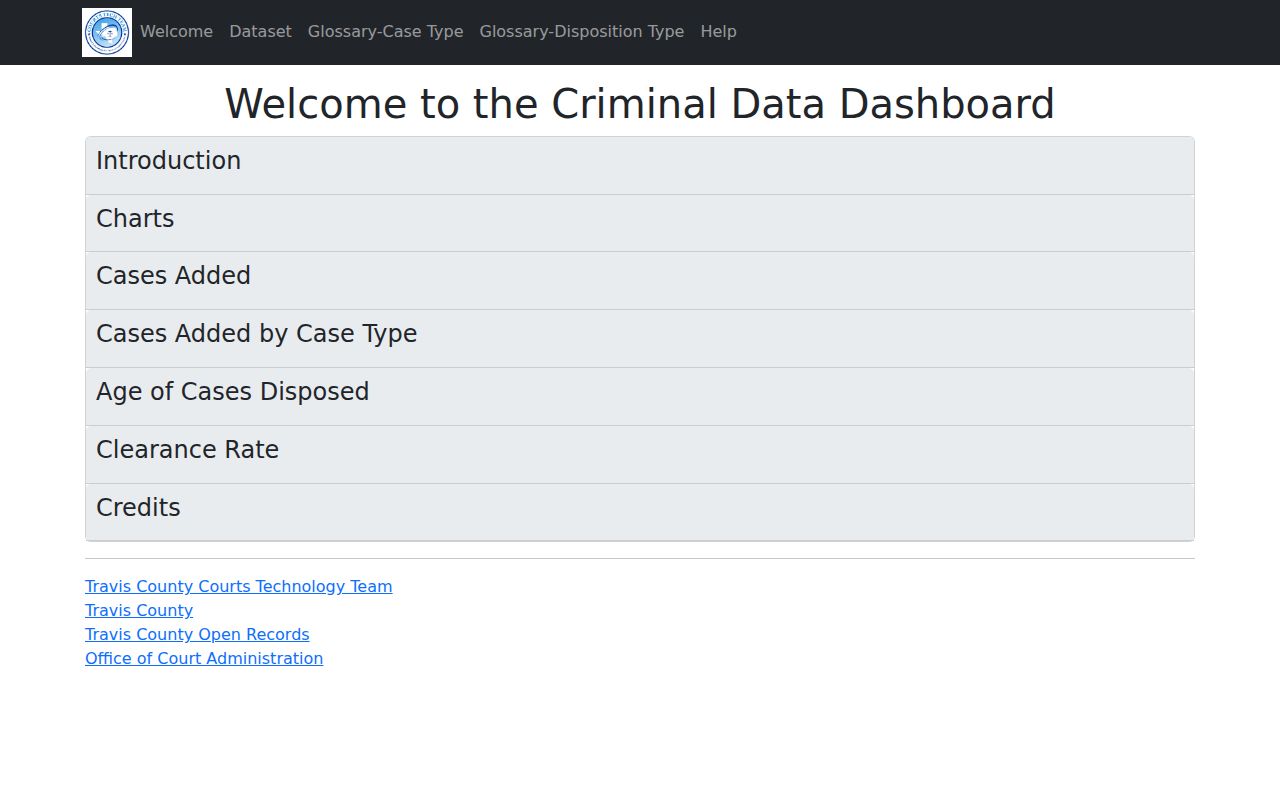
It sets the scene, though no dashboard can answer for a single Travis County court docket entry.
Older Travis Criminal Records
Online felony coverage at the District Clerk starts in 2008. Anything older lives on paper or microfilm. Ask the Criminal Division to run that search and estimate the copy cost. Mail your request to District Clerk Records Request, P.O. Box 679003, Austin, Texas 78767. One case number per request form.
District Clerk Criminal Division
501 W. 11th St., Room 2.300
Austin, TX
512-854-9420, option 3
districtcriminalrecords@traviscountytx.gov
Criminal Court Administration handles setting questions at 512-854-9244, while the clerk keeps the court records. The coordinator assigned to a court can confirm any reset or schedule change there.
Public Access and Sealed Criminal Dockets
A public adult felony record can list identifiers, parties, counsel, filings, hearings, and how the case ended. Images are another matter. They may need an account, arrive redacted, or stay restricted. Juvenile cases and sealed matters can be missing from a normal docket search. So can expunged records, nondisclosed material, and protected identifiers.
So a blank result proves nothing. Check the venue, the clerk, and the spelling. Recheck the case number, the date, and the online coverage again. Then ask whether a rule or court order limits the display. Texas draws a line between judicial administrative records and the case records judges decide cases on.
Key Rules:
Texas Rule of Judicial Administration 12 generally opens judicial records subject to exemptions, but it is not the routine rule for case-file access.
Texas Government Code § 552.0035 directs judiciary access to Supreme Court rules or other law.
Texas court rules require sensitive data to be restricted or redacted as applicable.
Certification comes only from the clerk who holds the original criminal court record. A printout pulled from an online docket carries no clerk seal.
Travis County Criminal Setting Reports
Two PDF reports sit beside the live docket search. One lists future settings by attorney. The other sorts them by arrested person. Annual district and county calendars mark jury and non-jury weeks too. Use them as calendar aids rather than full case histories.
Suppose a report and Odyssey disagree. Check the generation date and the newest setting event first. Then call the assigned coordinator, because an older PDF can hide a court update, and any reset request should be confirmed before anyone counts on the proposed date.
Travis County Criminal Document Access
The anonymous Register of Actions may show a filing. A motion, order, or judgment can appear without opening every image. Registering, or holding an authorized access role, can reveal more. Sealed and redacted items stay under control either way. A printer control just copies the public view; it is not certification.
Name the exact item you need. A docket sheet, a charging instrument, a signed judgment, and a certified disposition are four different records. Give the clerk the document name and case number. You get an accurate quote for the search, copy, and certification charges.
Travis County Criminal Search Gaps
Missing filing? First confirm which clerk received it and allow time for processing. A case older than the online coverage needs the paper or microfilm route. When warrant detail, a juvenile matter, or a protected identifier is absent, an access rule may be the reason rather than an oversight.
Start with the venue check. The District Clerk holds felony records, the County Clerk holds Class A or B misdemeanors, a precinct clerk handles county Class C, and a municipal clerk handles city cases. Run that sequence and many blank Travis County criminal docket searches clear up fast.